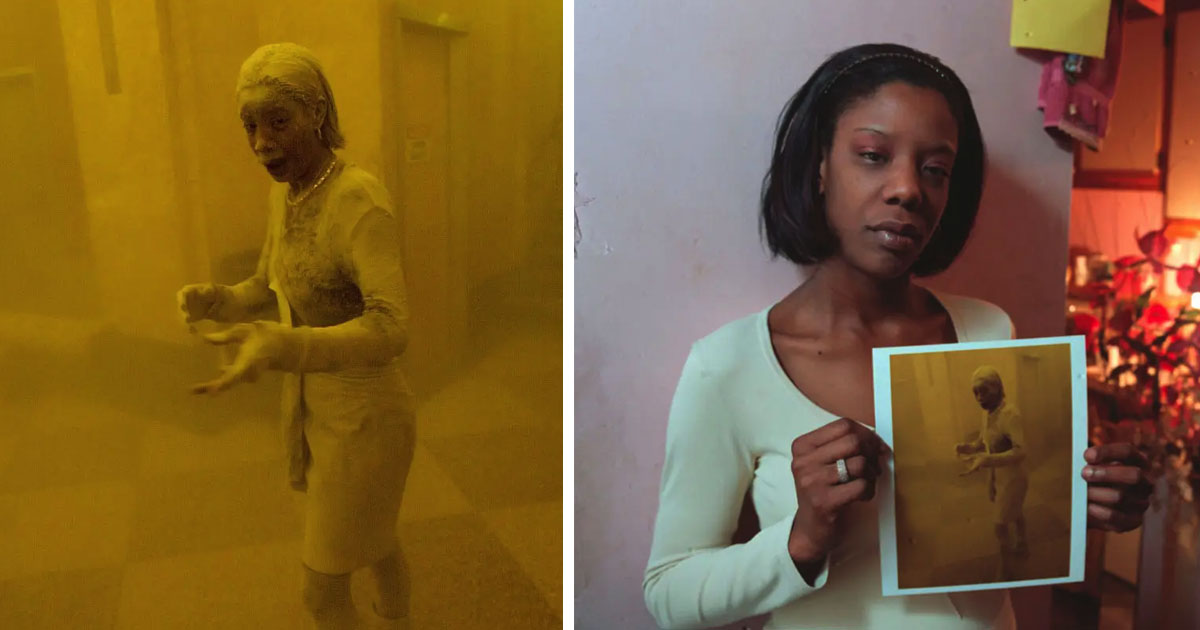

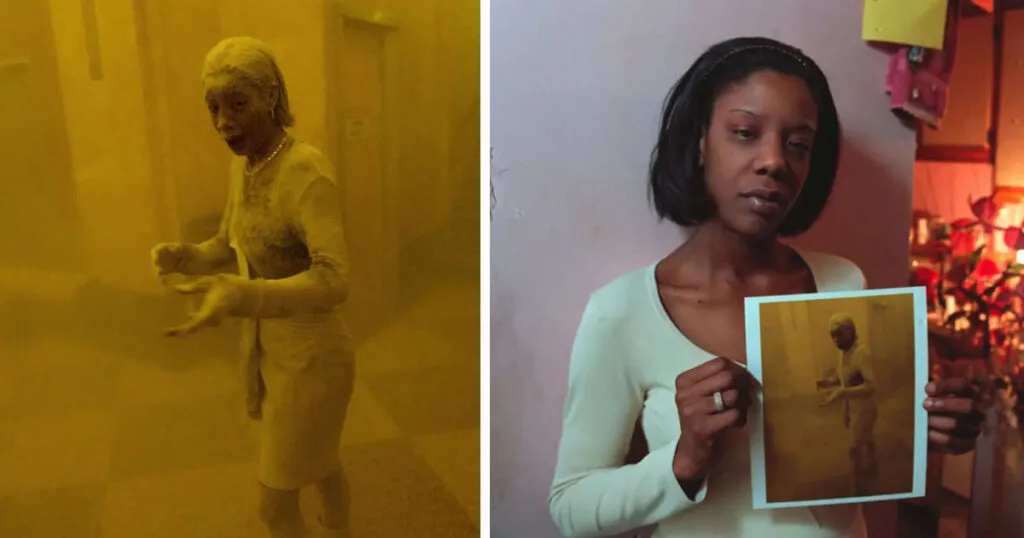
As the world pauses to reflect on a quarter of a decade passing since the tragic events of September 11, 2001, the haunting image of a woman shrouded completely in grey debris remains etched in the global consciousness. Nearly 3,000 lives were lost on that fateful morning, shattering the illusion of national invulnerability and leaving an indelible scar on modern history. Among the countless haunting visuals broadcast across international networks, one photograph stood out as a universal emblem of survival and shock. A young woman, draped head to toe in thick pulverized concrete dust, stood frozen outside the crumbling towers. Captured by Agence France-Presse photographer Stan Honda, the photograph later earned a permanent place on Time Magazine’s prestigious list of the 25 most powerful images ever recorded.
The woman behind the lens-captured stillness was Marcy Borders, a 28-year-old mother of two from New Jersey who had only recently embarked on a new professional chapter. Just one month into her employment as a legal assistant at Bank of America, Borders found herself stationed on the 81st floor of the World Trade Center’s North Tower when history violently intervened. ‘I was picking the junk off the desk, getting ready to start my day. That was when the plane hit,’ Borders recounted in an interview with The Independent. Ignoring her supervisor’s initial instructions to remain at her desk until emergency services arrived—a decision that almost certainly spared her life—Borders plunged into the chaotic stairwells alongside a terrified mass of humanity seeking escape.
A Look Back at the Iconic Journey of Dust Lady
Navigating the stairwells proved to be a harrowing trial of human endurance and psychological torment. The internal infrastructure of the skyscraper was heavily compromised, forcing frantic evacuees to switch routes amid rising smoke and terror. ‘Hundreds of people were trying to get out. My stairwell was badly damaged and we had to move stairwells, I was convinced we were going to die,’ she recalled. Witnessing horrific injuries and incomprehensible carnage in the stairwells pushed her psychological limits to the absolute edge. ‘There were wounded and the injured, it was too much for one to witness. I saw people with things sticking out of them, covered head to toe in blood. I couldn’t understand it. What I saw was carnage, and I thought, “God, I’m going to die anyway.”’
Emerging from the crippled skyscraper did not grant immediate safety, as the surrounding plaza was an apocalyptic storm of falling debris and collapsing masonry. It was precisely at this frantic juncture outside the North Tower that Stan Honda captured the defining frame of her life. Remarkably, Borders remained completely unaware that her likeness had been immortalized until her mother spotted the striking image in the news the following day and contacted the photographer directly. While escaping the immediate physical collapse was a miracle, the psychological weight of the catastrophe began an insidious, long-term unraveling of her life, plunging her into a profound depression that would last for years.
 News22 Visual Archive • In-Depth Coverage
Prince Harry and Meghan Hit Back at King Charles’ Bombshell Letter Over UK Return
The trauma of September 11 metastasized into severe mental health struggles and substance abuse, robbing Borders of her stability and custody of her two children. ‘It was like my soul was knocked down with those towers,’ she confessed to the New York Post in 2011, reflecting on a decade lost to debilitating anxiety and survivor’s guilt. Every airborne aircraft triggered intense panic attacks, and encounters with strangers on high-rises instilled paralyzing paranoia. Seeking escape from the relentless mental anguish, she fell into crack cocaine addiction. ‘My life spiraled out of control. I didn’t do a day’s work in nearly 10 years, and by 2011 I was a complete mess… I started smoking crack cocaine, because I didn’t want to live.’
Global Reactions and Words of Remembrance for Dust Lady
Turning a vital corner, Borders checked into a rehabilitation facility later that year, achieving sobriety and successfully reuniting with her children. However, the toxic cloud she had inhaled on that September morning had already begun its silent assault on her physical health. In August 2014, doctors diagnosed her with stomach cancer, an aggressive malignancy that she firmly believed originated from the hazardous particulate matter embedded in her lungs and body during the attacks. ‘I definitely believe it because I haven’t had any illnesses. I don’t have high blood pressure, high cholesterol, diabetes,’ she noted to the New Jersey Journal. ‘How do you go from being healthy to waking up the next day with cancer?’
After a courageous four-year medical battle, Marcy Borders passed away on August 24, 2015, at the age of 42, leaving behind a grieving family and a profound legacy. ‘Not only is she the “Dust Lady” but she is my hero and she will forever live through me,’ her daughter Norelle shared with the Post. Beyond her individual tragedy, Borders’ premature death mirrors a staggering public health catastrophe. According to official data from the World Trade Center Health Program, more than 9,000 individuals have succumbed to illnesses directly linked to the toxic aftermath of the attacks, including over 600 firefighters. Today, the cumulative death toll from post-9/11 environmental illnesses has surpassed the tragic loss of life recorded on the day of the attacks itself, serving as a permanent reminder of the disaster’s enduring, generational cost.
Elon Musk Warns Earth Has Months to Pivot AI Infrastructure to Space Before Terrestrial Power Collapse