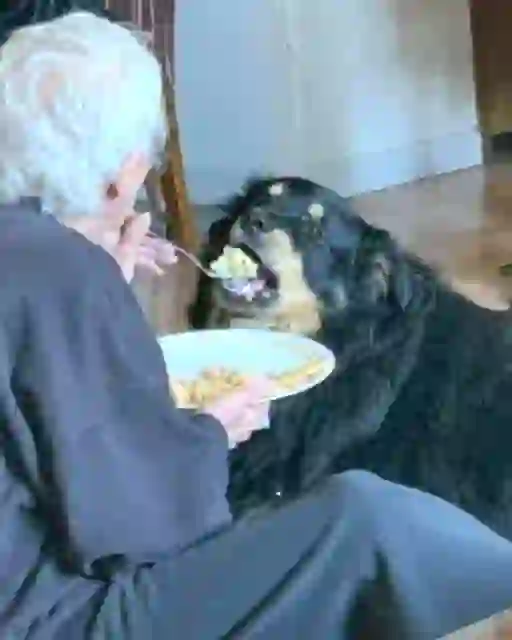
He started feeding the dog off his plate—but then I saw what was really going on.
It started the day my grandpa moved in with us. We’d converted the den into a bedroom for him, stuck a recliner near the window, and filled the bookshelf with his Louis L’Amour novels and old photo albums. He didn’t say much the first week—just nodded and shuffled around the house with the slow, careful steps of someone who didn’t fully trust the ground beneath him.
He’d had a minor stroke two months prior, and his doctor said routine was everything now. That, and engagement. Keep him stimulated. Talk to him. Include him.
It was harder than I thought it would be.
Grandpa Roman wasn’t a big talker to begin with. He was an old-school kind of man, the type who whittled pieces of wood into nothing just for the sake of having something in his hands. He’d been a mechanic, then a hardware store owner, then a retired widower who spent most of his days watching Westerns with the volume way too high.
So when he and Rizzo started bonding, it took all of us by surprise.
Rizzo, our hulking, shaggy Bernese mix, was the sort of dog who could make grown men cross the street. But to Grandpa, he was a gentle giant. Within a week, Rizzo was curling up at the foot of Grandpa’s recliner like some oversized guardian angel.
It wasn’t long before Rizzo started following him everywhere. And I mean everywhere—bathroom breaks included. If Grandpa dropped his cane, Rizzo would nudge it back toward him with his nose. If Grandpa took too long to get out of bed, Rizzo would bark until someone checked on him.
We thought it was sweet. We thought, “Well, maybe Grandpa’s found his reason to keep going.”
But then came the eggs.
Every Sunday, without fail, Grandpa would shuffle into the kitchen before anyone else was up and start making scrambled eggs. He could barely hold the spatula steady, but somehow he always managed. And every time, without exception, he’d serve the first few bites to Rizzo—right off his own plate.
I used to think it was adorable. A man and his dog, having breakfast like old friends.
Until I overheard him one morning.
It was early—earlier than usual. I was headed to the kitchen for coffee when I stopped in the hallway. I heard Grandpa talking. Not just mumbling, but whispering like he was confiding in someone.
“Such a lovely tradition, don’t you think? Always making eggs on Sundays.”
I stood frozen, the ceramic mug in my hand forgotten.
My grandma, Hazel, had died two years ago. She was the one who used to make him eggs every Sunday. She’d wake up early, whip them with milk and a dash of pepper, and serve them to him with toast and jam. He never made them himself. Not once in sixty years of marriage.
And yet here he was. Making them. Talking to Rizzo.
That was the first time I felt the sting of something deeper. I wanted to believe it was just a memory. Maybe the eggs reminded him of her. Maybe he just liked the comfort of pretending.
But it didn’t stop there.
He started calling Rizzo “Hazie” when he thought no one could hear. He began brushing Rizzo’s thick fur with one of Grandma’s old hairbrushes. I found a pair of her earrings on the nightstand one day, next to a dog treat.
I didn’t know what to do.
I talked to my mom about it, but she just looked tired. “If it brings him comfort, let it,” she said. “He’s not hurting anyone.”
But it felt like a line had been crossed. Like something fragile inside him was breaking and no one wanted to admit it.
Then came the night everything changed.
It was late, and a thunderstorm had rolled in. Rizzo hated storms—always had. Normally, he’d hide under the couch or pace until it passed. But that night, he stayed beside Grandpa, unmoving, eyes fixed on him like he knew something we didn’t.
At around 2 a.m., I heard a bark.
I rushed downstairs and found Grandpa on the floor, dazed, blood on his forehead. He’d tried to get up to close the window and lost his balance. Rizzo had barked so loud he woke up the whole house.
The paramedics said he might’ve laid there for hours if Rizzo hadn’t sounded the alarm.
That night at the hospital, Grandpa clutched my hand tighter than he ever had before. He kept whispering, “Hazie saved me… she saved me again.”
And that’s when it hit me.
It wasn’t just confusion.
It was love.
Some part of Grandpa had rewired itself to keep her close. In the absence of Grandma, he’d poured every ounce of memory, affection, and devotion into the creature who never left his side. Maybe it wasn’t rational. Maybe it wasn’t healthy. But it was human.
The doctors called it “reminiscence-based coping,” part nostalgia, part psychological preservation. They recommended cognitive therapy, but we all knew Grandpa wouldn’t go. He’d lived his life by his own rules. He wasn’t about to start sitting on some couch, spilling feelings to a stranger in khakis.
So we met him where he was.
We started leaving little things for him to find. Grandma’s old music box. A scarf she used to wear. My mom even started making eggs with his old Sunday recipe, the one he always claimed was “nothing special” but secretly loved.
And Rizzo? He kept doing what he always did. He stayed.
A month later, I sat with Grandpa on the back porch. The sun was setting, casting long orange streaks across the sky. He looked peaceful, his hand resting on Rizzo’s head.
“I know he’s not her,” Grandpa said softly, eyes on the horizon. “But sometimes… sometimes when I talk to him, it’s like she answers.”
I didn’t know what to say, so I just nodded.
And then he added, with a small smile, “She would’ve liked you being the one to find out.”
I blinked. “What do you mean?”
Grandpa turned his eyes to me. “She always said you see things. Not just what’s in front of you—but what’s behind it. Beneath it. You’ve got her eyes, you know.”
That moment stayed with me.
Not because it was profound or tear-jerking, but because it felt like a bridge—between past and present, memory and love, grief and grace.
Grandpa never stopped making eggs for Rizzo. But he also started eating more himself. Laughing more. Talking more.
And sometimes, just sometimes, I’d catch him humming one of Grandma’s favorite tunes under his breath.
These days, when people ask me how to help someone grieving, I tell them this story.
Because grief doesn’t always look like tears or silence. Sometimes, it looks like scrambled eggs and a dog named Rizzo.
If this touched you, share it. Someone you know might be feeding eggs to a memory, too.