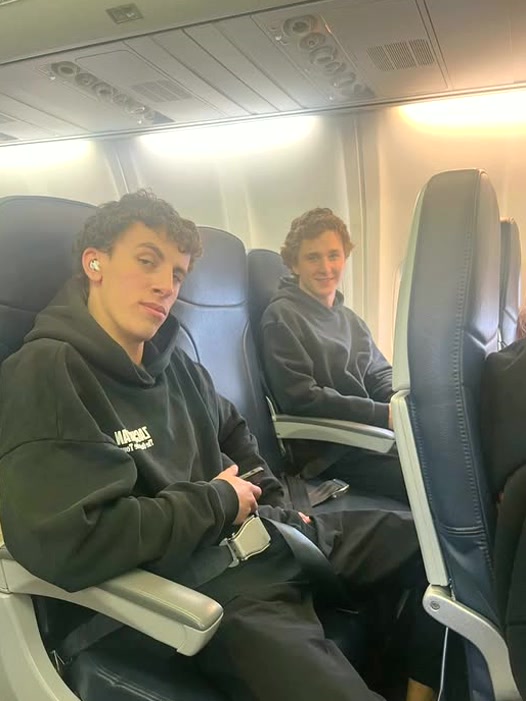
I don’t normally get riled up on planes. I’m the “headphones in, mind my business” type. But this kid? This smug little teenager in oversized designer headphones and a vintage hoodie that probably cost more than my rent? He tested me.
I boarded early and saw someone already in 17C—my aisle seat. At first, I thought maybe I read it wrong, but nope. I double-checked my boarding pass. It said 17C. I leaned over and said, “Hey, I think you might be in my seat.”
He looked up, didn’t even take his earbuds out, and said, “Yeah, I know. I like the aisle. You don’t mind taking the middle, right?”
Like it was no big deal. Like I was just gonna smile and slide into the middle like I’d been assigned there from birth.
I gave him a second. Maybe he’d crack a smile or say he was joking. He didn’t.
The aisle was clogging up, so now flight attendants were giving me that “keep it moving” look. I could feel people behind me getting impatient, sighing dramatically like I was the problem here.
So I sat down. Middle seat. Stewing. He leaned on the chair like a king and pulled his hoodie over his eyes.
That’s when I decided to play the long game.
I have a rule when I fly: pick your battles. Sometimes, it’s not worth it to argue. But this time, I felt disrespected. This was a cross-country flight from Newark to LAX—six hours if we were lucky. Being stuffed in the middle seat for that long was not on my agenda, especially when I’d done everything right to pick the aisle. I had a strategy in mind: stay calm, bide my time, and keep my eyes open for the right opportunity.
I stayed quiet at first, but I was determined to re-claim my seat. Once we reached cruising altitude, the seatbelt sign dinged off. People got up to grab stuff from the overhead bins or use the restroom. The moment our flight attendant, a cheerful-looking woman named Marta, came by with her beverage cart, I gave her a wave.
“Excuse me,” I said politely, looking over at the teenager. His hoodie had slipped enough for me to see that he was half awake, but still ignoring me. “I believe there might be a mix-up with the seating. My boarding pass says 17C, but I’m in the middle seat right now.”
Marta arched an eyebrow. “Your seat is 17C? That’s this one,” she said, pointing at the teen’s seat. “May I see your boarding pass?”
I handed it to her with a tight-lipped smile. The kid pretended not to notice. Then, very casually, he raised his headphone earpad just enough to say, “I just really prefer the aisle, so I asked them if I could switch. People switch all the time, right?”
“But you didn’t ask me,” I responded in a calm voice. I noticed Marta’s expression shift from polite to firm.
She cleared her throat. “Sir,” she said, addressing the kid, “this passenger is assigned to the aisle seat. We can only seat passengers in the seat on their ticket unless both parties agree to switch. Did you both agree to this?”
He shrugged. “Not exactly.”
“I’ll need you to move, then,” Marta said, though not harshly. Flight attendants have that special tone that’s both soft and unyielding.
Well, this was my moment, right? Yet, I wanted him to at least acknowledge his rudeness. He rolled his eyes in slow motion, flicked his hoodie back, and muttered, “Fine.”
But here’s the thing: while we were having that exchange, I overheard the couple behind us. The older gentleman in 18C was coughing up a storm. His companion kept patting him on the back, passing him lozenges. He looked frail, pale. It seemed like he really needed the aisle in case he had to get up often. Part of me wondered if maybe I should just let them move up, but I wasn’t about to pay the price of a middle seat for a total stranger’s convenience, especially after the kid had been so dismissive.
Meanwhile, our teenage seat thief actually stood up, but he didn’t move into the middle seat. He started rummaging around in his pocket, looking for something. He had a boarding pass, but it was for the middle seat in row 19. He was apparently supposed to be behind me, not even in my row at all. He let out a huff. “I mean, if it’s that big of a deal,” he said to me, “you can have it back.”
All that attitude. He still didn’t take off his fancy headphones. He was acting like I was the one putting him out. Now, remember, I said I decided to play the long game. I wanted him to learn something here, not just toss him aside. So I gave a small smile and asked Marta if she would mind waiting a second while we sorted this out.
She paused, then nodded. “Of course. Let me know if you need me,” she said, heading down the aisle to serve the next row.
Now it was just me, the teenager, and a few watchful eyes from other passengers. The tension was thick enough to cut with those flimsy plastic airline knives. Finally, I spoke in a low voice.
“You obviously like the aisle seat,” I said. “And I get it—it’s more comfortable, especially if you’re tall or if you need to get up a lot. But I paid for my seat. You can’t just decide the rules don’t apply to you.”
He shrugged again. “Well, I was hoping you wouldn’t care.” A smirk danced on his face. “It’s just an airline seat, right?”
I took a deep breath. I could have yelled at him or threatened to get a flight attendant to forcibly relocate him, but that’s not me. And it wouldn’t solve much—he’d just keep doing it to someone else. That’s when I remembered something I’d once heard an older colleague say to a pushy coworker.
I leaned in, and in the calmest voice I could muster, delivered the one sentence that shut him down completely: “You’re old enough to know better, and young enough to learn something here.”
He blinked. I don’t think he’d ever heard that before. You could almost see the gears turning. It wasn’t some big insult. It didn’t involve me raising my voice or calling him names. It was a simple statement, telling him that he wasn’t a child, and it was time to act like an adult. The message landed right on that line between calling him out and encouraging him to change.
He finally pulled off his headphones and stared at me. “What’s that supposed to mean?”
I shrugged. “It means you still have time to fix your behavior before you start losing people’s respect. You can make it right, right now.”
His cheeks turned pink. He glanced around, noticing that people nearby were listening. There was a couple in the row across the aisle eyeing him. A tall man in front of us was also leaning sideways, trying to catch the conversation. The teen’s bravado started to crumble.
He cleared his throat. “Look, man, I’m sorry,” he mumbled. “I guess I didn’t think it was that big of a deal.” He stepped into the aisle, motioning for me to reclaim my rightful seat.
I thanked him quietly, settled into 17C, and let him shuffle back to 19B—his actual seat. For a few minutes, I felt a rush of vindication. I had stood my ground. But I also wondered if I should say anything else. A quick glance behind me, and I saw him hunched over, hood up, fiddling with his headphones. That’s when I sensed something off. His eyes flicked around in a way that didn’t just scream “annoyed.” He looked… stressed.
The flight continued as normal: beverage service, peanuts, in-flight movie. About an hour later, I saw him stand up and wander to the back of the plane. When he returned, he kept wiping at his eyes, like he’d been crying. At first, I assumed maybe he was just upset about our seating confrontation. But then Marta, who was coming down the aisle again, paused by him.
“Everything okay, sweetie?” she asked in a gentle voice.
He shook his head quickly. I looked away, pretending not to eavesdrop, but I caught a soft snippet of him saying something about “hospital” and “my mom.” Marta crouched down beside him, whispering words I couldn’t catch. The kid pressed his lips together, nodded vigorously, and then gazed out the window. My heart gave a little twist. Suddenly, the entire “he took my seat” fiasco took on a new context.
We still had three hours left in the flight. I settled in, thinking about how I’d come across and hoping I hadn’t been too harsh. Sometimes, people are dealing with stuff we can’t see. It doesn’t make their actions correct, but it might explain why they’re not exactly on their best behavior.
Two hours later, we hit turbulence. The kind that makes your stomach flip. The pilot turned on the fasten seatbelt sign, and everyone hunkered down. I glanced back. The kid—no, more like a young guy—was gripping the armrests, looking pale as a sheet. I decided to take a risk. Once the turbulence eased a bit, I stood up, carefully made my way to his row, and said, “Hey. You doing okay?”
He looked startled, then shrugged. “I’m fine,” he muttered, though his shaky voice told a different story.
I glanced at the empty aisle spot next to him. “May I sit for a second?”
He hesitated, then gave a tiny nod. I sat, not wanting to hover awkwardly in the aisle.
“Look,” I said softly. “I overheard a bit earlier. I’m sorry if you’re going through something tough.”
He stared at me, letting out a shaky breath. “My mom’s in the hospital,” he said quietly, voice breaking. “They found something—some kind of mass—in her lungs. I’m flying out to see her now, and I don’t even know… I don’t know if she’s gonna be okay.” His eyes filled with tears he tried to blink away.
My heart clenched. “I’m sorry to hear that,” I said. “I know you must be worried. Travel can really mess with your head in those moments.”
He nodded. “I shouldn’t have taken your seat,” he admitted. “I was just tired, and I couldn’t stop thinking about… stuff. I didn’t mean to be such a jerk.”
I took a steadying breath. “It’s all right. We all do things we regret when we’re stressed. Hope your mom recovers soon.”
A look of relief crossed his face. “Thanks.”
I gave his shoulder a light pat, then headed back to my seat. The rest of the flight was quieter. No more tension. By the time we started our descent, my frustration was replaced with empathy. I was glad I’d said what I said—he needed that wake-up call. But I also felt good about understanding his situation.
When the plane finally landed, we all grabbed our stuff from the overhead bins. As we shuffled into the aisle, he pulled off his headphones and tapped me gently on the arm.
“Hey,” he said. “I’m… um… I appreciate you hearing me out.” His gaze dropped to the floor for a moment. “Sometimes it takes somebody calling you out to realize you gotta do better.”
I nodded. “We all need that sometimes,” I said. “Be safe, and I hope everything goes well with your mom.”
He gave me a tiny smile, a real one this time, and disappeared into the crowd heading for baggage claim.
On my way to the ride-share pickup, I kept thinking about what had happened. People step on each other’s toes all the time—whether it’s a stolen seat, a harsh word, or a snapped comment. But often there’s a deeper reason behind it. It doesn’t excuse bad manners, but it makes me think maybe we should all look a little closer before we lose our cool. You never know if the person annoying you has a way bigger burden on their shoulders than you can see.
So here’s the lesson: Stand up for yourself—absolutely, because we all deserve respect. But if you can, do it with empathy. It’s easy to yell at someone. It takes more effort to see them as another human being with struggles of their own. Even if they’re “old enough to know better,” they might be fighting battles you can’t imagine. Offer them a chance to learn. Offer them a chance to change. They might surprise you.
If you found this story meaningful, please hit the like button and share it with someone who could use a reminder that respect and compassion can go hand in hand. You never know whose day—or life—you might change by passing it on.